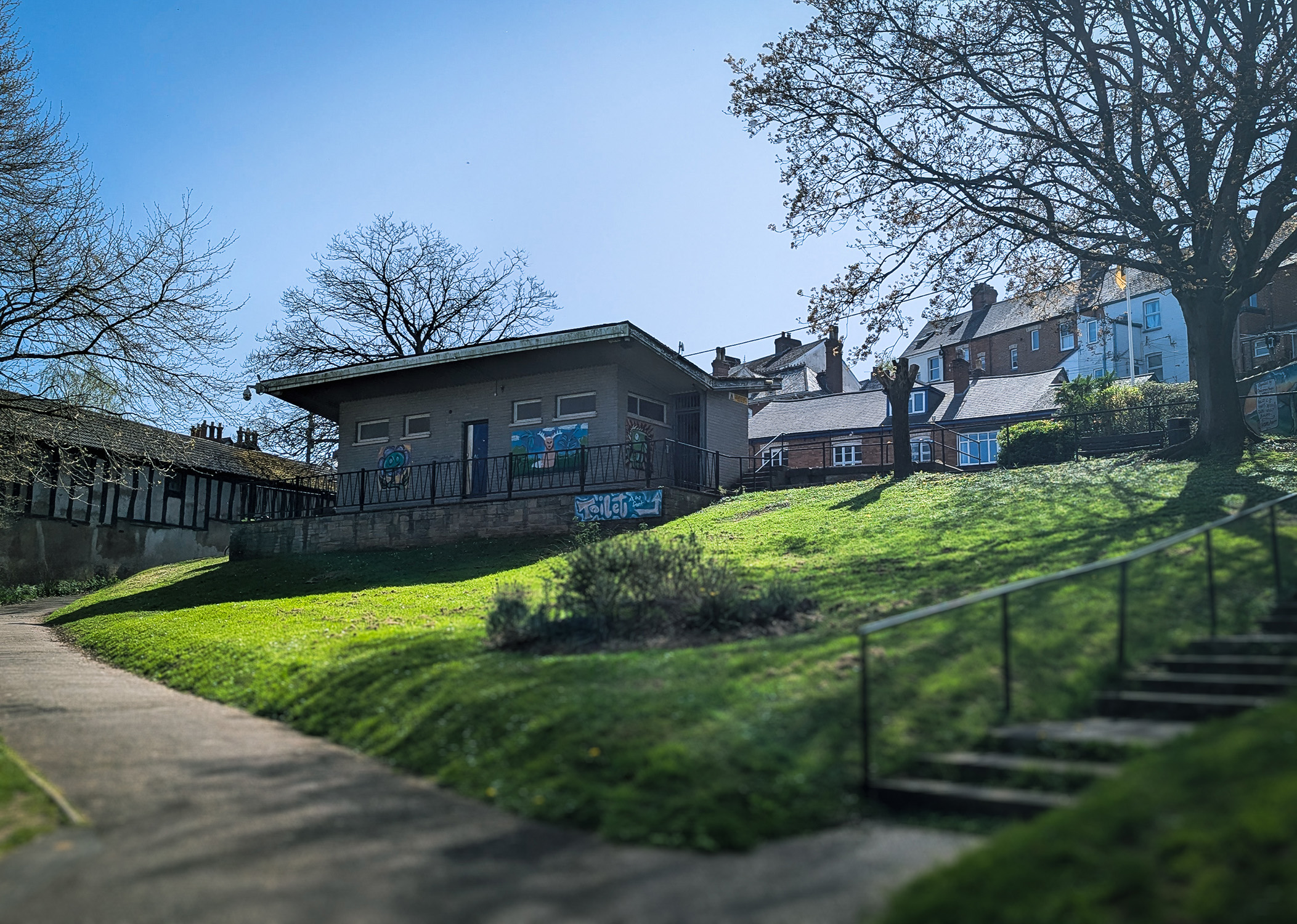
My dear commoners,
One learns that the proposed “Park House” local theatre project has received overwhelming public support, which is splendid news, though perhaps not in the way its admirers imagine. For what appears to have happened is not that the town has unanimously embraced a fully costed, rigorously tested, physically grounded scheme with all practical difficulties sensibly resolved. No. Rather, several hundred people were asked whether they liked the general idea of culture, enjoyment, inspiration, coffee, and pleasant civic uplift — and, in scenes that stunned absolutely no one, many replied that they did.
Marvellous. Next week, I am told, researchers hope to confirm strong local support for sunshine, handsome architecture, and not being struck in the face by a rake.
This is the difficulty with these surveys. They are so often presented as though they were tablets brought down from the mountain, when in reality they amount to asking the public whether they are broadly in favour of nice things happening somewhere. And the public, being for the most part quite attached to nice things, tends to say yes. Quite right too. If one asks the average resident whether they’d enjoy a vibrant cultural venue full of performances, creativity, sociability, and artisanal coffee, they are hardly likely to hiss and retreat into the shrubbery.
The remarkable thing is not that people supported it. The remarkable thing is that anyone thinks this settles anything.
One might as well stand in the High Street and ask, “Would you like beauty, entertainment, and a flourishing civic life?” and then treat the resulting nods as a solemn mandate from history itself. It is not consultation so much as organised flattery. The public is invited to imagine the best possible version of a thing, and when it approves, this is triumphantly recorded as evidence that all awkward earthly concerns may now be treated as secondary to the prevailing mood.
In this case, residents were apparently encouraged to picture a delightful cultural hub where the performances are stirring, the atmosphere is civilised, the coffee is the sort that arrives in cups too small for the price, and all practical constraints have quietly fallen down a well. One imagines ample charm, murmuring audiences, tasteful lighting, and somewhere outside a miraculous parking arrangement made possible only by sorcery, land reclamation, or the sudden evaporation of half the county’s motor carriages.
Because yes, parking did, in the end, intrude, as reality so often does when people are trying to showcase a vision.
A few dreary but entirely reasonable souls apparently raised practical concerns about parking, access, funding, feasibility, and what one might broadly call the physical world. These are the usual beastly interruptions, of course, forever barging into grand local dreams with their tape measures, invoices, and tiresome insistence on cause and effect. But happily, such objections appear not to have been allowed to spoil the general ecstasy. They have instead been filed, one assumes, under some heading such as Negative Energy, Insufficiently Arts-Forward, or Peasant Anxiety About Space and Money.
This is very much the modern style. Vibes first. Logistics later. Ask questions only once everybody has already fallen in love with the rendering.
The local paper, naturally, has apparently described the results as overwhelming, which in journalistic village dialect usually means “a fair number of people filled in a form after being asked whether they approved of delight.” Quite so. If one conducts a poll entitled Would You Like a Lovely Cultural Thing to Exist? and the response comes back largely positive, this is not exactly proof that the stars themselves have aligned and endorsed the project. It merely proves that the public is not instinctively hostile to theatres, coffee, or pleasure.
Which, if anything, reflects rather well on the public.
What it does not prove is that the awkward bits have vanished. It does not conjure parking spaces from the ether. It does not make funding less slippery, nor feasibility less beastly, nor geography more accommodating. It simply means that when invited to imagine a cheerful artistic future with all complications tastefully blurred out, the townsfolk did not respond by demanding a quarry and a munitions dump instead.
I am not mocking the arts, you understand. The arts are splendid. They civilise the soul, improve conversation, and provide the lower orders with something to clap at besides loose horses and fireworks. What I am mocking is this particularly oily strain of civic boosterism in which enthusiasm is treated not merely as welcome, but as a substitute for arithmetic.
There is always a point in these schemes where someone asks a vulgar practical question — usually about cars, money, traffic, access, or whether there is any sane way for several hundred people to arrive at once without the surrounding roads turning into an operetta of mutual resentment — and is then made to feel as though he has entered the orchestra pit and relieved himself in the trombone.
How dare he. How very dare he introduce matter into a discussion otherwise proceeding quite nicely on air.
And so the doubter is gently repositioned, not as a citizen asking a fair question, but as a problem. He is lacking vision. He does not understand the arts. He is being narrow. He has failed, somehow, to grasp that culture transcends logistics. This is all tremendous fun until opening night, at which point the audience discovers that transcendence still requires somewhere to leave the blasted motor carriage.
One jolly fellow reportedly remarked that he had not realised the arts were powered by denial. Quite. That may be the finest summary of the whole enterprise. For there is a peculiar local habit of treating criticism not as useful friction against fantasy, but as a kind of moral stain. The project must be loved cleanly, brightly, and without those ugly practical footnotes by which lesser mortals navigate the world.
But projects, alas, do not live on affection alone. They live on access, money, structure, realism, and all the other dreary ingredients that visionaries prefer to leave off the poster.
Still, I do enjoy the image of these survey results now being hoisted triumphantly into funding applications and planning discussions, accompanied by solemn declarations that “the community is behind the project.” Yes, perhaps it is. The question is whether the community will also be able to get to the project, park at the project, and leave the project without becoming trapped in a twilight crawl of reversing vehicles and muttered oaths.
For there is a subtle but meaningful difference between support and operability. I support Venice, but I should still like to know where the lavatories are.
At Houndstone Hall, this sort of poppycock would not survive until elevenses. If I proposed converting part of the estate into a refined cultural venue and then announced, with enormous self-satisfaction, that the household was “overwhelmingly supportive” because most people had admitted to liking music, theatre, and decent coffee, I should deserve to be pelted with stale vol-au-vents. Perkins, my Labrador, though admittedly stronger on pheasants and the strategic concealment of bones than arts infrastructure, understands the essential point perfectly: enthusiasm is lovely, but it does not create parking. If eight spaniels are invited to luncheon and there are only three bowls, one has not designed a bold new culinary future. One has designed a squabble.
So let us be clear. It is entirely possible that the theatre project is a good idea. It may yet be a very good idea. But a survey showing that people like the sound of culture is not the same thing as proving the scheme works. It is merely proof that Crediton residents do not object in principle to the existence of enjoyment.
And one is glad to know it.
Still, one hopes that before the next burst of euphoric headline-writing, someone somewhere will ask the truly vulgar questions about space, money, movement, and whether “overwhelming support” can also be persuaded to park half a mile away in the rain.
Spiffing.