My dear commoners,
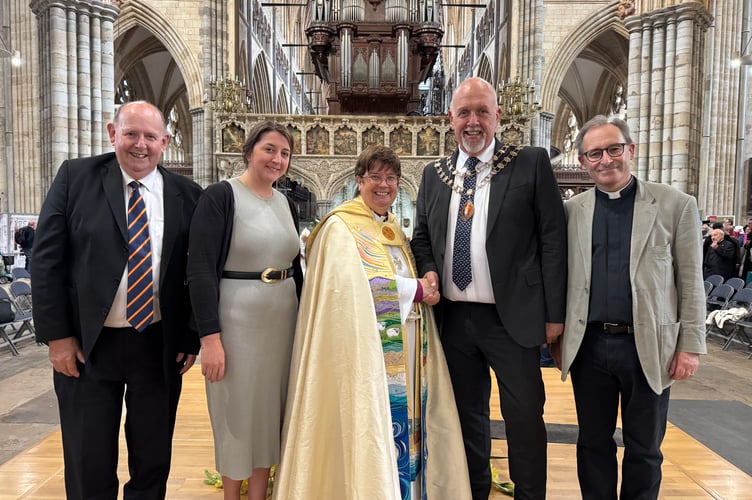
One has lately been reading the Mayor’s New Year message, and I confess it produced in me that rare civic sensation one usually reserves for damp upholstery: a mixture of bafflement, politeness, and the suspicion that something earnest but essentially troubling has just occurred.
The Mayor, with admirable warmth and a very steady grip on generalities, has called upon the people of Crediton to be kind, love thy neighbour, and help make the town “an even better place for us all to live in.” A noble aim, of course. Who among us is against a town becoming better? Only a maniac, a tax inspector, or someone trying to reverse a horsebox through the High Street. The difficulty is that this stirring vision appears to consist almost entirely of saying nice things in the general direction of reality and hoping reality is so touched by the gesture that it improves itself.
It is less a plan than a scented candle.
We are told that 2026 will bring fun, laughter, tears, joy, despair, hope, luck, and many challenges, which the commoners will doubtless recognise as a remarkably comprehensive description of Tuesday, or indeed, any other day of the week. One must admire the breadth of it. It covers everything, predicts nothing, and leaves one none the wiser except in the broad philosophical sense that life will continue to happen.
Marvellous. Fetch the bunting.
The Mayor also reminded us that Crediton is a place “so special in so many ways,” which is true enough. It is special in the way ancient towns often are: handsome in parts, faintly unhinged in others, and held together socially by history, weather, and people posting furious paragraphs on Facebook about parking, dog fouling, and whether the council has once again spent money on piffle. It has charm, certainly. It also has potholes, that awfully dreadful McDonald’s, and the occasional local character who appears to regard public decency as an optional continental fad. So yes, special covers it nicely.
But the real treat came with the exhortation that we should all reflect on how best to “be kind and love thy neighbour.”
Splendid. Very scriptural. Very cosy. Very little clue what one is actually meant to do.
Is one expected to bake a sponge? Hug a stranger? Nod more supportively at the butcher? Refrain from describing the town council as a travelling amateur pageant of muddle and self-importance? The phrase has all the practical force of a tea towel. When one asks how, exactly, this kindness is to be measured, encouraged, or turned into anything beyond a seasonal puff of goodwill, one gets the usual municipal murmurings about matters becoming clearer in due course — which is local-government dialect for “we’ve said the warm bit and are hoping no one notices there isn’t a cold, hard bit attached.”
Naturally, this has all the makings of a classic council strategy:
Be positive,
Appear united,
Commit to nothing,
And under no circumstances let detail spoil the mood.
One can almost picture the draft priorities now, lovingly arranged in bullet points by someone with a lanyard and a weak spot for beige prose:
Unity, subject to agreement.
Open-mindedness, within reason.
Action, once suitably discussed.
Progress, if everyone could stop asking for specifics.
It is administrative blancmange.
And there is something especially local-governmentish about the notion that a town may be improved chiefly by encouraging everyone to feel a bit nicer. It is the sort of philosophy one adopts when all the difficult practical work has been left in the airing cupboard, and no one can find the key. Roads, services, upkeep, planning, communication, civic competence — all very beastly and concrete. Much easier to urge the peasantry to cultivate a general atmosphere of warmth, as though the town might be improved by collective cardigan energy alone.
One does not object to kindness, you understand. Kindness is lovely. Kindness is civilised. Kindness prevents people from becoming councillors. But as a governing principle, it is somewhat incomplete. A town cannot run on smiles alone. Smiles do not repair benches. Goodwill does not answer emails. A tender heart is no substitute for clear thinking, proper priorities, and the occasional adult decision made without two hours of waffle and a working group named after optimism.
Still, one must not be too harsh. There is a touching innocence in all this. A sort of wholesome hope that if the people of Crediton are sufficiently encouraging to one another, the place will somehow become better by moral osmosis. Perhaps a weekly “Kindness Indicator” could be erected on the High Street, measuring civic improvement by the number of people who pass the Post Office without muttering something murderous. Perhaps councillors could issue regular warmth updates. Perhaps the whole town could gather monthly to exchange supportive nods while absolutely nothing structural improves in the background.
It would be ghastly, of course, but at least it would be on brand.
The deeper problem is this: the message sounds rather less like a programme and more like a well-meaning headmaster addressing an assembly after someone has set fire to the bins. One hears plenty about values, spirit, togetherness, and making the town better, but precious little about what anyone with actual authority intends to do beyond encouraging the rest of us to be lovely.
It is government by uplift. Management by vague niceness. Civic leadership reduced to the hopeful release of positive sentiments into the atmosphere, like a metaphorical white dove.
At Houndstone Hall, this sort of poppycock would not survive until elevenses. If I announced to the household that the estate would henceforth become “an even better place for all of us to live in” through kindness, neighbourliness, and good cheer, but neglected to mention any practical measures whatsoever, I should rightly be regarded as having taken a blow to the head. Perkins, my Labrador, though admittedly stronger on pheasants and mud, understands the basic distinction perfectly: wagging one’s tail is not the same thing as running the estate. If something is to be improved, one improves it. One does not merely beam at it and hope it feels encouraged.
So let us wish the Mayor well. Let us all be kind, by all means. Let us love thy neighbour where practical .. and legal. But let us also acknowledge that a town is not made better by inspirational fluff alone. It requires decisions, standards, action, honesty, and fewer sentences that sound as though they were written on the back of a church leaflet during a power cut.
Until then, Crediton remains what it has long been: a very decent place populated by mostly sensible people, periodically asked by civic worthies to mistake warm words for an actual plan.
Spiffing.