My dear commoners,
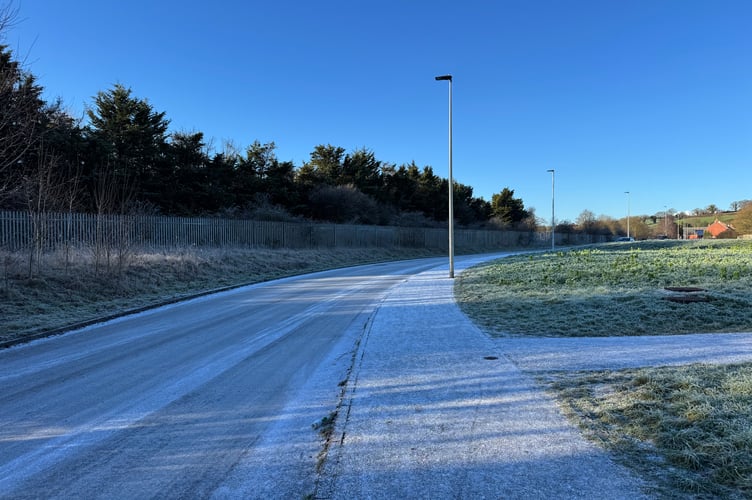
One is delighted to report a great triumph of modern local democracy. After a week in which residents were obliged to traverse Joseph Locke Way as though auditioning for Dancing on Ice: Minor Injury Special, a councillor has finally secured action on the matter of gritting.
Not from the council, naturally.
Not from highways.
Not from whichever other tribe of clipboard-wielding spectres usually emerges to explain why nothing can be done before Easter.
No — from Tesco.
Yes, that’s right. The supermarket has now stepped in to perform a basic public function, apparently because it became clear that if the state waited any longer, half the town would be arriving at the GP surgery horizontal. Thus, we enter the next glorious phase of British civic life, in which essential infrastructure is managed not by the authorities but by whichever retailer happens to have the nearest store.
It is a magnificent symbol of the age.
Joseph Locke Way, you see, is not some obscure farm track leading to a barn and a disappointed goat. It serves a railway station, a doctor’s surgery, bus routes, and a large Tesco. In any sane civilisation, this would suggest a certain urgency. In ours, it appears merely to have created a mystical zone of bafflement in which everyone uses the road, everyone needs the road, people fall over on the road, and yet responsibility for the road is treated as a sort of metaphysical riddle best left to druids, land lawyers, and whichever poor sod last opened the deeds packet.
For days, the place remained untreated, while the public performed involuntary pirouettes on the ice and attempted the morning commute with the wary gait of people crossing a bomb disposal range in socks. Ankles were imperilled. Dignity was lost. Elderly persons shuffled forth with the facial expression normally associated with crossing enemy territory under mortar fire. And through it all, officialdom stood at a discreet distance, murmuring what one assumes were the usual sacred phrases:
Complex ownership
Outside our remit
Must not rush into gritting
Quite so.
Eventually, a councillor managed to persuade Tesco to do the decent thing and salt the road. A genuine success, if also a rather grim commentary on the condition of the republic. One can only imagine the negotiations:
“Could the public authority responsible for safe access please act?”
“No.”
“Could the supermarket, whose main qualification is selling hummus and inflatable paddling pools, have a go?”
“Yes, all right then.”
And there we are. Civilisation restored by the frozen foods aisle.
Tesco, to its credit, appears to have grasped the basic principle rather more quickly than the machinery of local government. If customers are slipping over en route to buy meal deals and paracetamol, this may be considered suboptimal. Not everything requires a strategy paper, a steering group, and six months of beige correspondence. Sometimes one simply flings grit at the dangerous bit and gets on with life.
This, one regrets to say, places Tesco several constitutional rungs above half the British state.
Devon Highways, I gather, responded with all the warmth and imagination of a cold spoon by essentially saying, “Not our road.” Splendid. One does admire the purity of it. There is a sort of bureaucratic haiku to those three words. Not our road. Not our problem. Not our peasants skidding toward A&E like startled gazelles.
And so the road lingered in that most beloved of British categories: important enough to matter, awkward enough to be ignored.
Residents, not unreasonably, had wondered why a road leading to a railway station, a GP surgery, and a supermarket was treated with all the urgency of a decorative driveway. The answer, as ever, is that no one could quite agree whose problem it was, and therefore the problem was permitted to sit there gleaming malevolently in the frost until commerce itself intervened.
This is how empires end. Not with invasion, but with Tesco gritting the approach road while the authorities hold a symposium on jurisdiction.
One naturally wonders where this ends. Today Tesco salts the tarmac. Tomorrow, perhaps it will repair potholes. Next year, planning applications may be decided at the customer service desk by a woman named Cheryl with a barcode scanner and more common sense than an entire chamber of councillors. Local elections might be held at self-checkout. Parking fines payable in Clubcard points. Birth certificates issued near aisle seven. Foreign policy subcontracted to Lidl.
Frankly, I have seen worse systems.
Particularly comic is the discovery that while some of Joseph Locke Way will now be gritted, certain very specific stretches remain untouched, having been identified with surgical precision as being just far enough away to count as Somebody Else’s Problem. One patch outside the railway station, I am told, remains in a sort of quantum state of public responsibility: not Tesco’s, not quite the council’s, perhaps the railway’s, perhaps God’s, but in any case certainly not to be addressed before a feasibility exercise, a consultation, and the end of winter.
It is deeply moving.
One pictures a resident lying on his back in that icy no-man’s-land while three authorities stand around him in hi-vis jackets debating ownership boundaries like medieval monks arguing over relics.
At Houndstone Hall, this sort of piffle would not survive until elevenses. If a road on the estate served the house, the stables, and the lower meadows, and people were skating down it like doomed courtiers, one would not spend a week pondering whose precise tarmac it was. One would grit the blasted thing and ask legal questions later. Perkins, my Labrador, though admittedly stronger on pheasants, mud, and opportunistic luncheon theft than highways law, already understands the core principle: when a path becomes dangerously slippy, you either make it safe or accept that you are run by idiots. Indeed, Perkins has shown more instinct for route management simply by avoiding frozen puddles on the lower drive.
So let us raise a respectful glass to the councillor who at least managed to shame, cajole, or otherwise maneuver a giant supermarket into doing what the public sector could not. It is undeniably a victory, though of the sort one receives in wartime after learning the village baker has taken over air defence.
And let us savour the wider lesson. With enough persistence, enough public embarrassment, and enough institutional buck-passing, even the most basic duties of civic life may eventually be outsourced to a place that also sells crumpets, bin bags, and novelty Easter eggs.
The peasants, naturally, will be expected to feel grateful that they may now reach the railway station without breaking a hip. And grateful they should be, I suppose. But one cannot help feeling that when the supermarket is the only body willing to grit the road to the doctor, the bus stop, and the railway station, the system has perhaps drifted a touch beyond merely “not ideal” and into the realms of complete administrative farce.
Still. The road is being gritted. The state has been replaced by Tesco. The empire staggers on.
Spiffing.